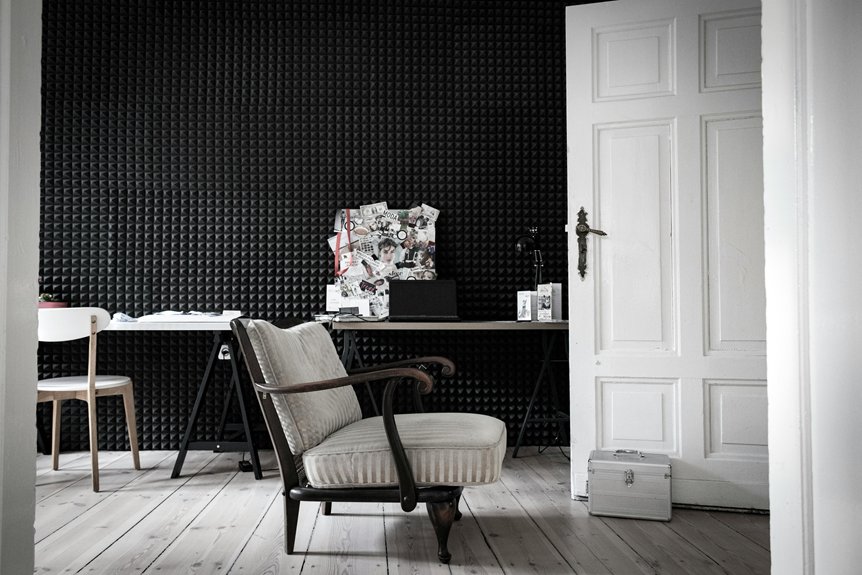
I’ve found that quieting your office starts with pinpointing noise sources—conversations, HVAC hum, or foot traffic—then choosing between absorption or masking. Acoustic panels (0.70 NRC minimum) on walls cost $200–$2,000 and work fast. Door seals run just $10–$50 but cut leaks significantly. For open plans, combine ceiling tiles, soft furnishings, and strategic partitions. Sound masking systems or white noise machines ($1–$3 per sq ft) mask distractions without renovation. Privacy pods handle urgent calls. Your specific layout and noise type determine which mix works best—and we’ll walk through each approach next.
Sound Absorption vs. Sound Masking: Which Strategy Fits Your Office?
When you’re trying to fix noise problems in your office, you’ve got two main approaches to choose from, and understanding the difference between them will save you time and money. Sound absorption uses acoustic panels and thick carpeting to reduce reverberation and echo bouncing around your space. Sound masking, meanwhile, adds ambient noise that makes speech less intelligible, protecting privacy in open areas. Absorption works best for controlling echo in smaller rooms and costs less to install yourself. Masking systems require professional installation with ceiling speakers, but they’re ideal when you need privacy across larger office layouts. Choose absorption for interior acoustics or masking for speech privacy, depending on what your space actually needs.
Assess Your Office: Layout, Noise Sources, and Soundproofing Goals
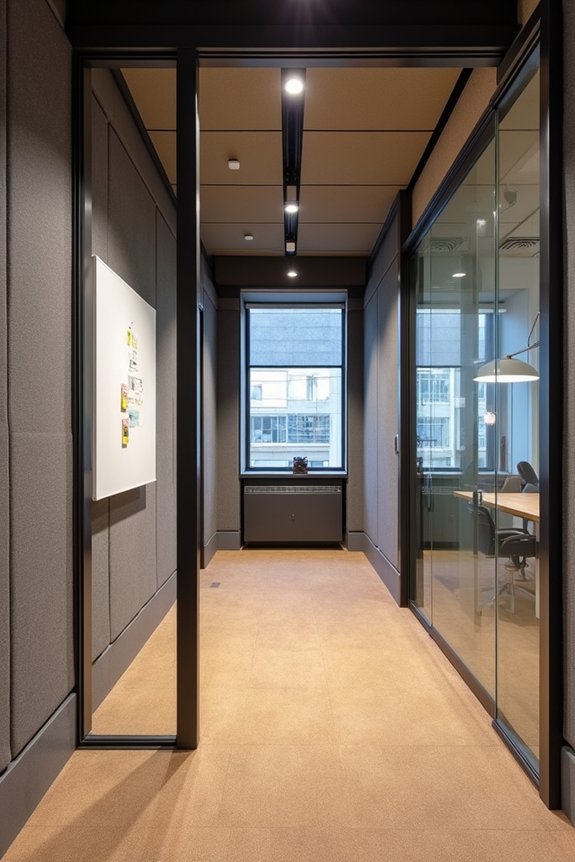
Before you pick any soundproofing solution, I’ll walk you through three essential steps: pinpointing where your noise actually comes from (whether it’s echo bouncing off hard surfaces in your space or chatter bleeding through walls from neighbors), understanding how your office’s size and layout affect sound movement, and getting clear on what you’re really trying to achieve—whether that’s keeping confidential calls private or helping your team focus despite background noise. These assessments take just an hour or two but’ll save you thousands by steering you toward the right combination of absorption panels, sound masking, or acoustic pods instead of guessing. I’ve seen offices waste budget on expensive soundproofing when they really just needed a $500 white noise system, so let’s nail down your specific situation first.
Identify Noise Sources First
Where’s that constant hum coming from in your office? Identifying your specific noise sources is the first step toward better office acoustics. Walk through your space and listen carefully. You’ll likely notice conversations, HVAC systems, servers, foot traffic, and equipment sounds. I categorize each as either intermittent (people talking, doors closing) or constant (air conditioning, computer fans). This distinction matters because it shapes your soundproofing strategy. Intermittent noise disrupts concentration differently than steady background hum. Spend fifteen minutes mapping where sounds originate—near windows, conference rooms, or open areas. Document what you hear. Understanding your specific noise sources prevents wasted effort on solutions that won’t address your actual problems.
Evaluate Space Layout Impact
How your office is arranged directly shapes where sound travels and where it gets trapped. I’ve seen how layout optimization affects noise reduction outcomes.
Here’s what I evaluate in every space:
- Open floor plans spread sound broadly, requiring strategic absorption panels and masking systems
- Partition placement creates natural barriers that localize conversations and equipment noise
- Quiet zones positioned away from high-traffic areas protect focus work and calls
- HVAC placement influences background noise levels across different zones
Well-designed office acoustics don’t require complete renovations. I identify your primary sound sources, then recommend targeted solutions. Installing 2–3 modular pods in interruption zones creates private call areas immediately. Understanding how your current layout affects sound propagation lets us build a realistic noise reduction plan that fits your space and budget.
Define Privacy and Focus Goals
The difference between a noisy office and a focused one often comes down to knowing what problem you’re actually trying to solve. Are you blocking conversations between departments, or just reducing echoes in your own workspace? Privacy and focus needs require different solutions. If you’re worried about speech intelligibility across the floor, you’ll want masking and absorption. If interruptions drain your focus, quiet zones or sealed conference rooms work better.
Map your noise sources first—open areas, conference rooms, shared equipment spaces—then define what success looks like for your team. Fewer interruptions? Clearer calls? Reduced distractions? Your answers shape everything that follows.
Start by identifying your specific goals, and you’ll invest in solutions that actually work.
Acoustic Panels: The Easiest Starting Point for Wall Absorption
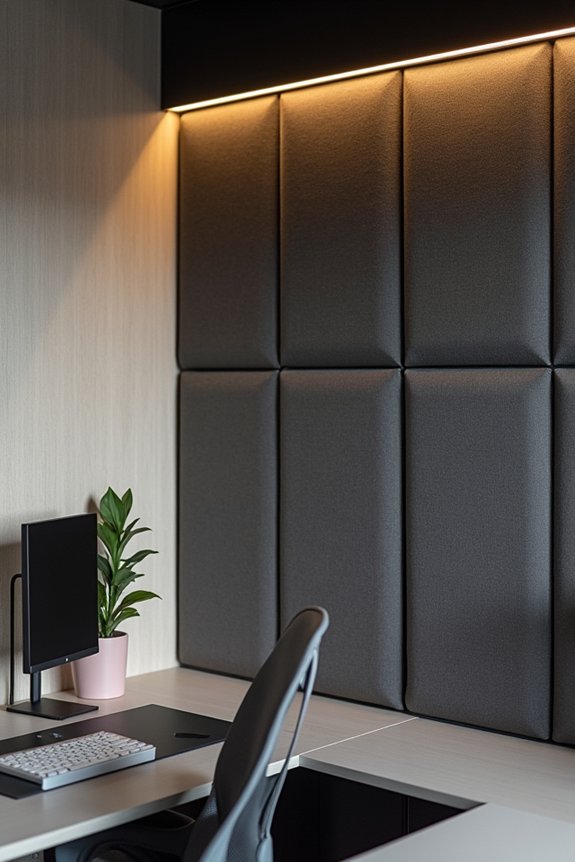
I’ve found that acoustic panels are your best first step if you’re serious about quieting your office at a reasonable cost without hiring contractors. You’ll want to understand three key things: where to place them and how to install them, what materials work best based on their NRC ratings, and how much you’ll actually spend compared to other soundproofing methods. Let me walk you through each of these so you can make an informed choice for your space.
Installation Methods And Placement
When you’re ready to tackle soundproofing your office, acoustic panels offer the most straightforward path forward, and I’ve found they’re worth starting with before exploring pricier solutions. Installation methods and placement significantly affect your results.
What I recommend:
- Mount panels on walls between sound sources and listening zones for maximum impact
- Position them on ceilings in conference rooms where echoes bounce strongest
- Use adhesive strips or brackets depending on your wall type and damage tolerance
- Choose panels matching your décor while prioritizing absorption ratings over aesthetics
Strategic placement outperforms random coverage. Focus on noise-prone areas first. You’ll notice reduced reverberation immediately, and your team will appreciate the quieter workspace you’re creating together.
Material Types And NRC Ratings
Now that you’ve got your panels positioned, understanding what you’re actually buying matters just as much as where you put them. I learned this the hard way when I grabbed cheap panels with low NRC ratings—they barely helped my echo problem.
| Material Type | NRC Rating | Best For |
|---|---|---|
| Fiberglass | 0.75-0.95 | High noise absorption |
| Melamine Foam | 0.70-0.85 | Mid-frequency control |
| Polyurethane | 0.65-0.80 | Budget option |
NRC ratings measure how well acoustic panels absorb sound across frequencies. Higher ratings mean better noise absorption. You’ll want panels scoring at least 0.70 for meaningful results. Matching your material choice to your specific noise problems—whether it’s traffic, conversations, or equipment—will impact your ability to create a quiet workspace.
Cost-Effectiveness For Office Spaces
Why spend thousands on structural soundproofing when acoustic panels deliver real results at a fraction of the cost? Panels offer the most practical entry point for sound control in offices.
Here’s why they’re cost-effective:
- DIY installation saves labor costs compared to hiring professionals for structural work
- Wall panels cost significantly less than ceiling treatments or full room sealing
- Higher NRC ratings target mid-frequency absorption where you need it most
- You’ll notice improvements in speech clarity without renovating your space
I placed panels at first-reflection points in my conference room and heard the difference immediately. The investment paid off quickly through improved focus and fewer distractions. Start with acoustic panels, then expand your soundproofing strategy as your budget allows.
Ceiling Tiles and Overhead Absorption for Open-Plan Offices
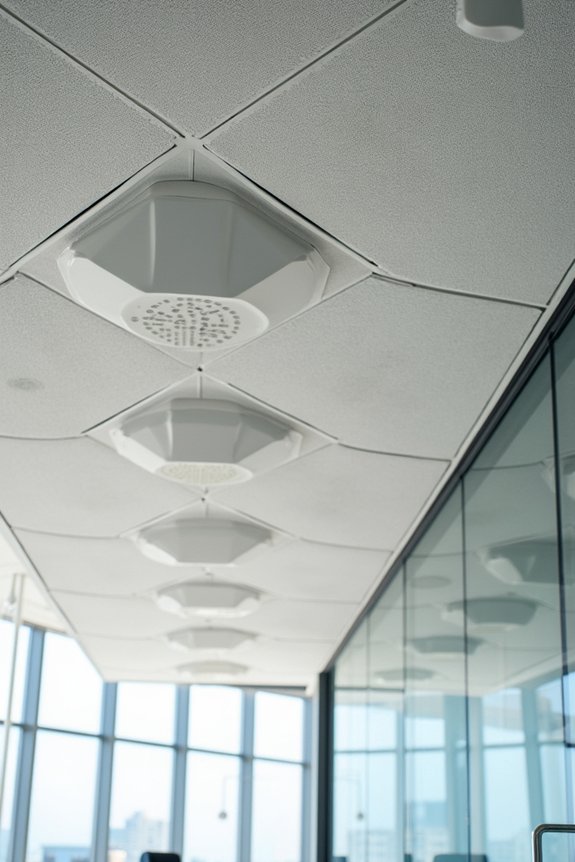
Overhead sound absorption is one of the most effective ways to address noise in open offices, and ceiling tiles are your most straightforward tool for getting it done. Strategically placing acoustic tiles throughout your ceiling interrupts sound reflections that bounce around large spaces. You’ll want tiles with higher NRC ratings—I recommend 0.80 or above for busy environments. When combined with wall panels and carpeting, ceiling tiles deliver measurable acoustic improvements.
| Tile Type | NRC Rating | Cost Per Tile | Best For |
|---|---|---|---|
| Standard Fiberglass | 0.70-0.75 | $8-12 | Basic offices |
| Premium Absorption | 0.85-0.95 | $15-25 | High-traffic areas |
| Fabric-Wrapped | 0.80-0.90 | $20-30 | Professional spaces |
| Eco-Friendly | 0.75-0.85 | $12-18 | Sustainable goals |
This layered approach creates quieter zones where concentration becomes possible.
Carpeting and Floor Pads: Why Soft Surfaces Matter
While ceiling tiles handle the sound bouncing around above your head, what’s underfoot matters just as much—and that’s where carpeting and floor pads come in. Thick carpet dramatically reduces reverberation by dampening sound waves instead of letting them bounce around your office. Here’s what you need to know:
- Thick carpeting absorbs more sound than thin options, creating quieter spaces
- Area rugs add localized noise reduction in individual offices
- Layering rugs over existing flooring enhances sound blocking without renovations
- Carpet complements other soundproofing methods for overall workspace quietness
You’ll want to balance noise reduction with maintenance needs. Thicker carpets perform better acoustically but may require more cleaning. When you layer soft surfaces throughout your office, you’re creating a comprehensive soundproofing strategy that tackles footfall and ambient noise together.
Heavy Drapes and Upholstered Furniture: Adding Absorption Without Renovations
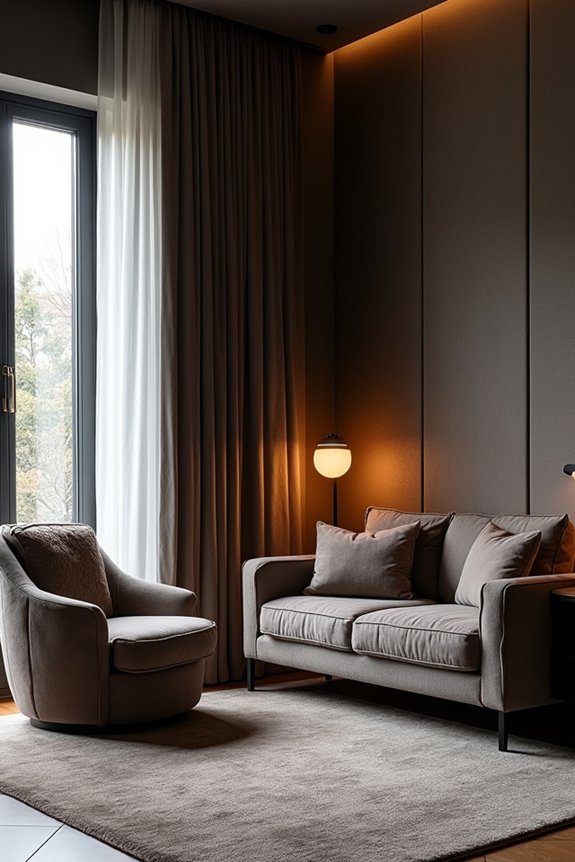
If you’ve ever noticed how a bare room echoes but a furnished one feels quieter, you’ve witnessed sound absorption in action—and that’s exactly what heavy drapes and upholstered furniture do for your office. I’ve found that thick, dense fabrics in drapes deliver noise reduction comparable to mid-range acoustic panels. When you hang them to cover walls or windows, they absorb mid- to high-frequency reflections and reduce reverberation significantly.
Layering these with plush seating and substantial-pile rugs creates quieter zones by converting echo energy into heat. Upholstered partitions work similarly, making open offices noticeably calmer. What I appreciate most is that this approach requires no renovation, costs less than panels, and works well with other treatments like door seals.
Seal Doors, Vents, and Gaps to Block Sound Transmission
If you’ve upgraded your doors and furniture but still hear voices bleeding through, I’d recommend focusing on the gaps that let sound slip past your defenses—door sweeps, weather-stripping, and caulk around vents are your best tools. When I sealed the gaps around my office door with a basic door sweep (usually $15-30) and added adhesive-backed weather-stripping along the frame, the difference was immediate and noticeable. You’ll also want to caulk around electrical outlets and vent openings with acoustic caulk, since these small spaces are powerful sound highways that undermine all your other soundproofing efforts.
Door Sweeps And Seals
One of the quickest wins you’ll find in soundproofing is sealing the gaps around your doors, and I’m talking about that space between your door bottom and the floor where sound just sneaks right through.
Door sweeps and seals effectively reduce sound leakage in your office. Here’s what to focus on:
- Install door sweeps along the bottom to block noise from hallways
- Apply weather-stripping around the frame edges for an airtight seal
- Add gasketed door edges for maximum sound blocking
- Check outlets and vents so sound doesn’t leak through them
Hollow-core doors benefit most from these upgrades. When you pair these strategies together, you’ll significantly reduce the noise sneaking into your space without changing how your office looks.
Caulking Vents And Outlets
Have you ever noticed how sound seems to travel right through the small openings around your vents and outlets? I discovered this when my office felt noisy despite having good doors. The solution? I started caulking with acoustical sealants around every outlet and vent opening.
Unlike standard caulk, acoustical sealants create an airtight barrier that dampens noise. I applied them around electrical outlets, HVAC vents, and return air grilles—anywhere gaps existed. The process took patience, but the results were real.
When I combined outlet caulking with my door seals, the ambient noise dropped noticeably. My colleagues commented on improved speech privacy. You’ll find acoustical sealants at most hardware stores. They’re worth the investment for serious soundproofing.
Weather-Stripping For Sound Containment
While caulking sealed the small gaps around outlets and vents, I realized my office door was still letting sound slip through underneath and around the edges. I needed a better solution, and that’s when I discovered weather-stripping.
Weather-stripping creates a tighter seal around your doorframe, blocking the gaps that commonly transmit sound between rooms. Here’s what I did to secure my space:
- Applied self-adhesive door sweeps along the bottom to stop sound from creeping underneath
- Installed door seals around the entire frame perimeter
- Chose materials specifically rated for sound reduction
- Combined weather-stripping with my existing caulking for maximum effectiveness
My hollow-core door benefited most from these improvements. The self-adhesive products made installation straightforward, taking about thirty minutes total. Now, I’ve built a multi-point sound containment system that works effectively.
Partitions and Cubicles: Creating Quiet Zones in Shared Spaces
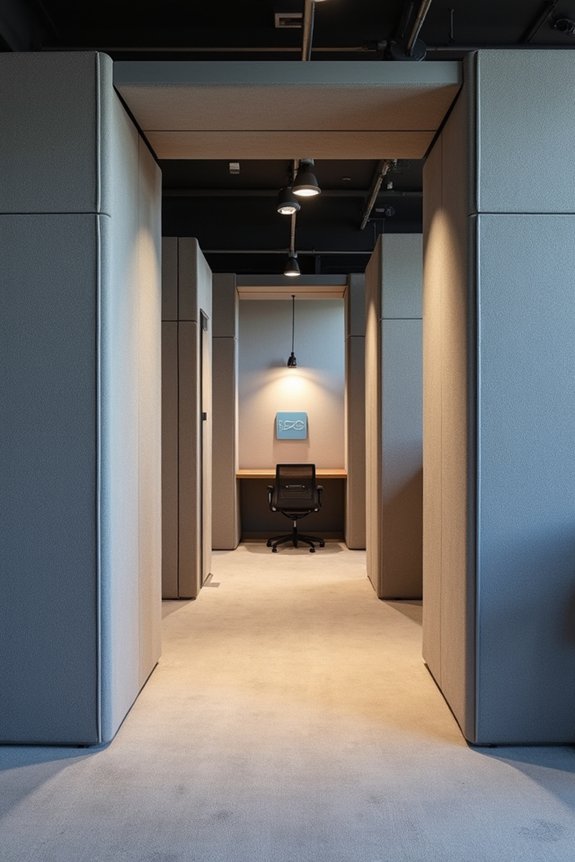
If you’re working in an open office, you’ve probably noticed how sound travels freely from desk to desk, making it nearly impossible to concentrate when your neighbors are on calls or collaborating loudly. Strategic partitions help reduce noise and create focused zones. Desk-height acoustic panels create privacy barriers that block conversations while maintaining sightlines. Moveable partitions offer flexibility as your team’s needs shift. Quiet Board™ panels absorb sound effectively without requiring construction, making installation straightforward. For overhead noise, hanging baffles add ceiling-level reduction. You can configure these elements based on your workflow—taller partitions for sensitive work, lower ones for collaboration areas. These noise reduction solutions help create the quieter environment you need to do your best work.
Privacy Pods and Phone Booths: Isolation When You Need It Most
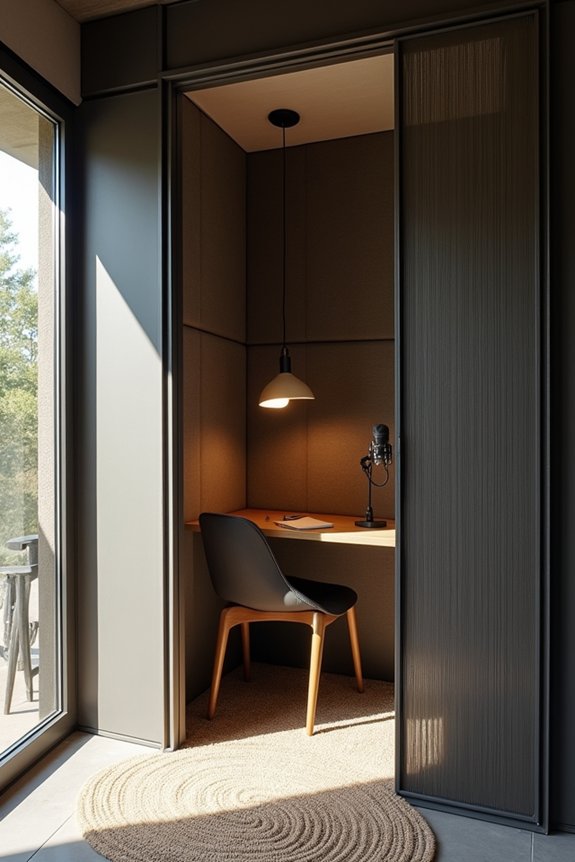
Sometimes the best way to find focus in a noisy open office is to step into your own private space, and that’s exactly what privacy pods and phone booths offer. I’ve watched teams improve their productivity by adding these modular solutions. Here’s what makes them work:
Sometimes the best way to find focus in a noisy open office is to step into your own private space.
- Layered walls absorb sound and reduce cross-talk effectively
- Sealed edges prevent noise from escaping or entering
- Controlled airflow keeps the space comfortable during calls
- Single-person booths install faster than larger meeting pods
You won’t need construction or lengthy renovations. Privacy pods provide immediate office acoustics improvements for hybrid teams. Whether you’re handling confidential calls or deep work requiring sound isolation, these booths fit seamlessly into existing layouts. I’ve found they’re especially valuable when growing teams need quick acoustic privacy without permanent changes. They’re practical, accessible, and genuinely improve how focused work happens.
White Noise Machines and Sound Masking: Masking Distractions You Can’t Block
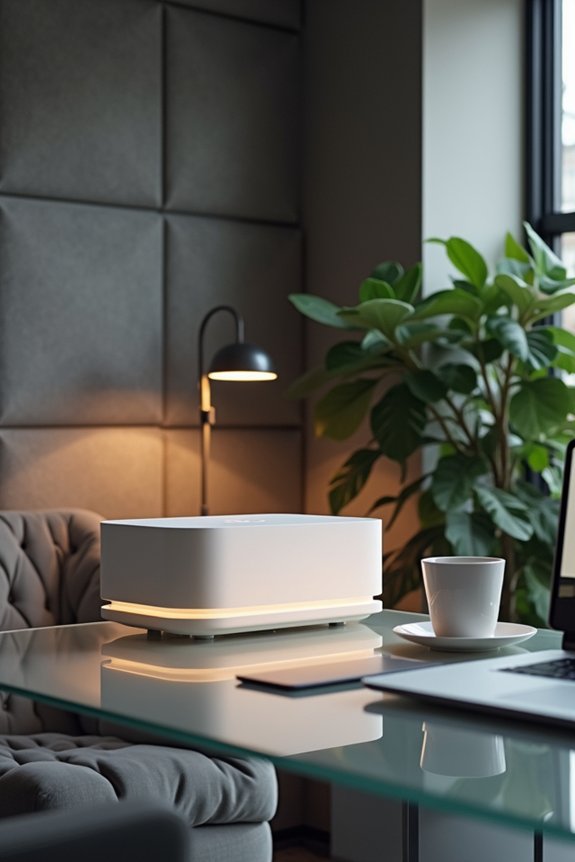
You’ve probably noticed that some office sounds—like a colleague’s phone conversation or keyboard clicks—stick in your brain even when you’re trying to focus, and that’s exactly where white noise machines and sound masking systems help. These tools work by raising the background noise floor, making conversations harder to understand across open areas. You can customize the volume and tone to match your distance from noise sources and personal comfort level. They cost less and install faster than full soundproofing. Professional sound masking systems need proper ceiling or speaker placement for uniform coverage, while simple white noise machines offer affordable noise reduction for individual workstations. Both strategies help you regain focus without major renovations.
Noise-Canceling Headsets: A Personal Supplement to Office Soundproofing
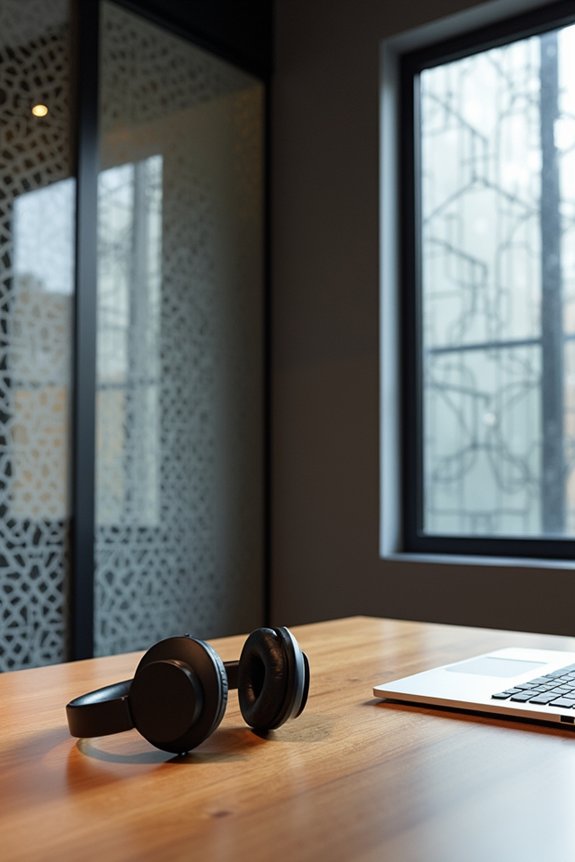
While white noise machines raise the overall sound floor around your workspace, noise-canceling headsets take a different approach—they create a personal sound barrier that travels with you. I’ve found that active noise cancellation (ANC) technology reduces ambient noise reduction by 20–35 dB, depending on your model and frequency profile.
Noise-canceling headsets create a personal sound barrier, reducing ambient noise by 20–35 dB depending on your model.
Here’s what makes noise-canceling headsets practical for open offices:
- They isolate you from nearby conversations, sharpening call clarity and focus
- ANC works best when paired with quiet zones rather than used alone
- The Orosound Tilde Pro offers adjustable settings for different environments
- Battery life, comfort, and software compatibility matter for all-day wear
I recommend pairing headsets with your existing soundproofing efforts. This combination creates a comprehensive approach that improves how you experience your workspace.
Budget Soundproofing: Which Solutions Deliver the Most Impact for the Least Cost
When I started soundproofing my office on a tight budget, I realized I didn’t need to spend thousands of dollars to make a real difference. I discovered that targeting the biggest noise problems first gives you the best results for your money.
| Solution | Cost Per Sq Ft | Installation Time | Noise Reduction |
|---|---|---|---|
| Door seals | $10–$50 | 30 minutes | High impact |
| Acoustic foam | $50–$200 | 1–2 hours | Good results |
| Acoustic panels | $200–$2,000 | Half day | Excellent results |
| Sound masking | $1–$3 | Professional | Moderate results |
| Modular pods | Mid-range | Fast | High privacy |
I started with door seals and weather-stripping around my entrance—inexpensive, fast, and immediately effective. Then I added acoustic foam panels to my walls. This combination cut outside noise considerably while keeping costs reasonable.